
Samsung Galaxy Book 3 Ultra with Nvidia GeForce RTX 4070 graphics, a stunning 16-inch 120Hz AMOLED display and an large trackpad, it’s truly a dream laptop. It can handle gaming without needing to be plugged in making it a strong competitor against the Dell XPS, ZenBook Pros, and MacBook Pros. This top-of-the-line laptop is Samsung’s first to feature a dedicated graphics card. It comes in both 14-inch and 16-inch models offering powerful performance with a starting price of just under $2,200.
Specifications
There is an issue displaying Amazon products. Please contact the administrator to check that.Galaxy Book 3 Ultra features an RTX 4050, a 13th-generation i7 processor, and 512GB of storage, all in a base configuration that costs about $250 less than a base M2 Pro MacBook Pro 16. If you want to upgrade, you can opt for an RTX 4070, an i9 processor, and 1TB of storage for around $3,000.
Both CPU options i7 and i9 are 45watt Intel 13th generation H Series chips, offering more power than the usual P-Series found in lighter laptops. It comes with 16 or 32GB of RAM, a 76watt-hour battery, Wi-Fi 6E, a fingerprint reader an impressive 1080p webcam, and decent quad speakers. However, in UK top-spec version is limited to 16GB RAM which may be a deal breaker if you choose the 4070 and i9. In US the store now offers a 32GB RAM option but note that the RAM is soldered and cannot be upgraded by the user. The entry-level model with the RTX 4050, Intel i7, and 16GB of RAM remains a strong contender.
RTX 4070 features 4608 quad-cores, 8GB of GDDR6 VRAM and a 60 watt TGP, positioning it as a mid-range GPU. It offers significantly higher frame rates and better performance compared to integrated chips like the XE found in the Galaxy Book 3 Pro. However, it doesn’t match the performance of a dedicated gaming laptop. Compared to the previous-gen RTX 3070 Ti mobile GPU, the RTX 4070 has more cores (28 vs. 28) but a narrower memory bus and lower bandwidth. This means you trade some raw power for increased portability.
Design and Display Quality
Build quality of the Galaxy Book 3 Ultra is excellent, featuring a sturdy aluminum chassis with no noticeable flex. Despite its impressive performance and large 16-inch screen, the laptop remains incredibly thin and light.
You can open it with one finger which adds a premium feel. However, the screen does wobble a bit especially when adjusting it to a comfortable viewing position. This wobble can be annoying, particularly if you’re using it on a train or plane, as it can cause the screen to shift downward. A more robust hinge would have improved stability.
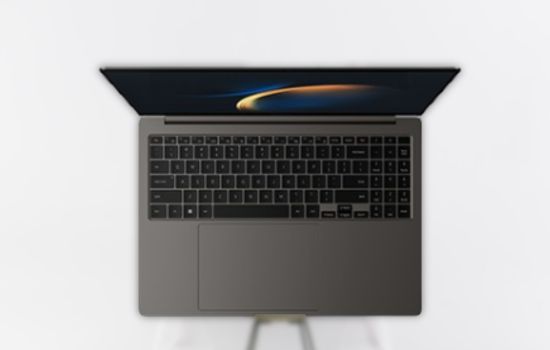
Galaxy Book 3 Ultra features a massive trackpad that’s very nice to use, but it does push the keyboard up resulting in tiny arrow keys and a shortened function row. While there is space for a numpad, I would have preferred a smaller trackpad to allow for a slightly larger keyboard. The keys, though functional have a rubbery softness that isn’t particularly satisfying. Despite this, the laptop’s portability is impressive at just 1.79 kilograms for a 16-inch model with these specs. If portability is your top priority, the smaller 14-inch version might be a better choice.
The port selection includes 2x Thunderbolt 4 USB-C ports, 1x USB-A 3.2 port, a microSD card reader, a 3.5mm audio jack, and an HDMI 2 port. It’s a bit disappointing that there’s no HDMI 2.1 port or full-size SD card slot, given the price and target audience. Inside, the laptop has a vapor chamber cooler and dual fans, with an upgradable PCIe 4 SSD and an additional slot for extra storage. However, the RAM is not upgradeable.
Screen is a major upgrade from previous models. Samsung has moved beyond their old 60Hz, 16:9 AMOLED displays to a superior 16:10 Dynamic AMOLED 2X panel with a 120Hz refresh rate. This results in a smoother more modern viewing experience.
Samsung’s Dynamic AMOLED 2X panel is brighter with enhanced HDR and more accurate colors. The 3K resolution which is between Quad HD+ and 4K offers a great balance between battery life and performance similar to the MacBook Pro. While it’s not ideal for native 4K tasks and is very glossy, leading to reflections, it excels in color accuracy with 100% sRGB, 95% Adobe RGB, and 99% DCI-P3 coverage.
Brightness is impressive exceeding Samsung’s claims with around 530 nits in SDR and 740 nits in HDR. It also meets the Display HDR 500 true black standard, making HDR content look stunning. Overall, the Galaxy Book3 Ultra’s display is exceptional and perfect for graphic artists, designers, and color-sensitive tasks.
Performance and Battery Life
But the big question is just how fast is this?
When using Premiere Pro for 4K projects, the Galaxy Book 3 Ultra handled effects and color corrections swiftly. In 3D apps like Blender and gaming, the RTX 4050 or 4070 significantly boosts performance. For instance, in F1 22 at Quad HD, I achieved around 80 FPS with medium settings on the 120Hz panel. At Ultra settings with ray tracing, FPS dropped but Nvidia’s new frame interpolation tech improved performance in demanding games like Cyberpunk with ray tracing and DLSS, you can get 43 FPS at QHD+ and high settings without ray tracing can exceed 100 FPS.
In Forza Horizon 5, I saw 60 FPS on medium to high settings and low 40s at max settings. Rainbow Six Siege ran smoothly at 144 FPS with DLSS set to balanced. And also excelled in the Time Spy frame stability stress test showing minimal GPU throttling, thanks to its effective vapor chamber and dual fans. It remains mostly silent, with fan noise only noticeable under heavy loads. The different fan and performance profiles in Samsung settings allow for customization.
The Galaxy Book 3 Ultra comes with a 76-watt hour battery and with light use you can expect around 7 to 8 hours of battery life. However, gaming on battery significantly impacts performance. For example, while playing Cyberpunk, the performance dropped by about 45%, and in Siege, the FPS plummeted from over 100% to just above 30%. For optimal gaming performance, it’s best to keep the laptop plugged in. Additionally, this uses a single USB-C cable for charging, eliminating the need for a bulky power adapter. The 100-watt charging capability means you can go from zero to 100% in about 90 minutes. Plus, you can use the same USB-C cable to charge your phone.
Compared to other Windows laptops, its cooling, performance, and battery life are impressive. The quad AKG-tuned speakers provide clear, loud sound without any tinny quality.
Webcam and Samsung Extras

Webcam on the Galaxy Book 3 Ultra delivers impressive 1080p video quality, better than many others I’ve tested. Even with studio lighting, it captures clear and detailed images. The laptop uses its built-in speakers and microphones, and offers useful features like eye contact mode, background blur, and auto-framing to enhance video calls. However, it does not support Windows Hello for face unlocking, so you’ll need to use the fingerprint reader for security.

Choosing a Samsung laptop offers added connectivity and smart features that integrate well with other Galaxy devices. For instance, Multi-Control lets you use your mouse and keyboard with your Galaxy S-series phone or tablet. Instant Hotspot automatically transfers raw photos from your Galaxy phone to the laptop. Additionally, Quick Share provides a seamless way to share files, similar to Apple’s AirDrop.
Galaxy Book 3 Ultra vs MacBook Pro
When comparing the Galaxy Book 3 Ultra to the MacBook Pro 16 with an M1 Pro both are in the same price range of around $2,500. The Samsung model costs about $250 more for its base configuration with 512GB storage and 16GB RAM and it features an Intel i7 13th-gen processor, while the MacBook has the M1 Pro chip.
For some, the choice between these two may come down to preference for macOS or Windows 11. Personally, I find the MacBook Pro M1 to be faster and quieter under load with the added benefit of consistent performance on battery power. The MacBook Pro also offers HDMI 2.1 more Thunderbolt 4 ports, a full-size SD card slot, superior speakers a better webcam, a more refined keyboard and trackpad and a brighter screen with thinner bezels though some might dislike the notch.
On the other hand, the Galaxy Book 3 Ultra is impressive for a Windows laptop, offering strong performance and battery life staying cool and quiet with build quality comparable to Apple’s. Its AMOLED screen provides high contrast and deep blacks, though it isn’t as bright as the MacBook’s mini LED display.
Ultimately, while MacBook Pro 16 stands out as the superior choice for me, especially if you prefer macOS and value top performance, the Samsung Galaxy Book 3 Ultra is worth considering if you prefer Windows, want gaming capabilities, or desire the performance of the 4050 or 4070 graphics card.
Final Thought
Samsung Galaxy Book 3 Ultra is a lightweight and powerful semi-workstation laptop. While it faces strong competition and has a few drawbacks such as a slightly wobbly screen, lack of a full-size SD card slot, no HDMI 2.1, a less-than-ideal keyboard and no 32GB RAM option, it still performs well overall. The battery life is decent, the webcam is excellent, and the build quality is solid with good thermals and a responsive trackpad. Compared to heavier models like the MacBook Pro 16 or Dell XPS 17, the Galaxy Book 3 Ultra offers a great balance of performance and portability. For most users, I recommend the base model with an Intel i7, RTX 4050, and 16GB of RAM.